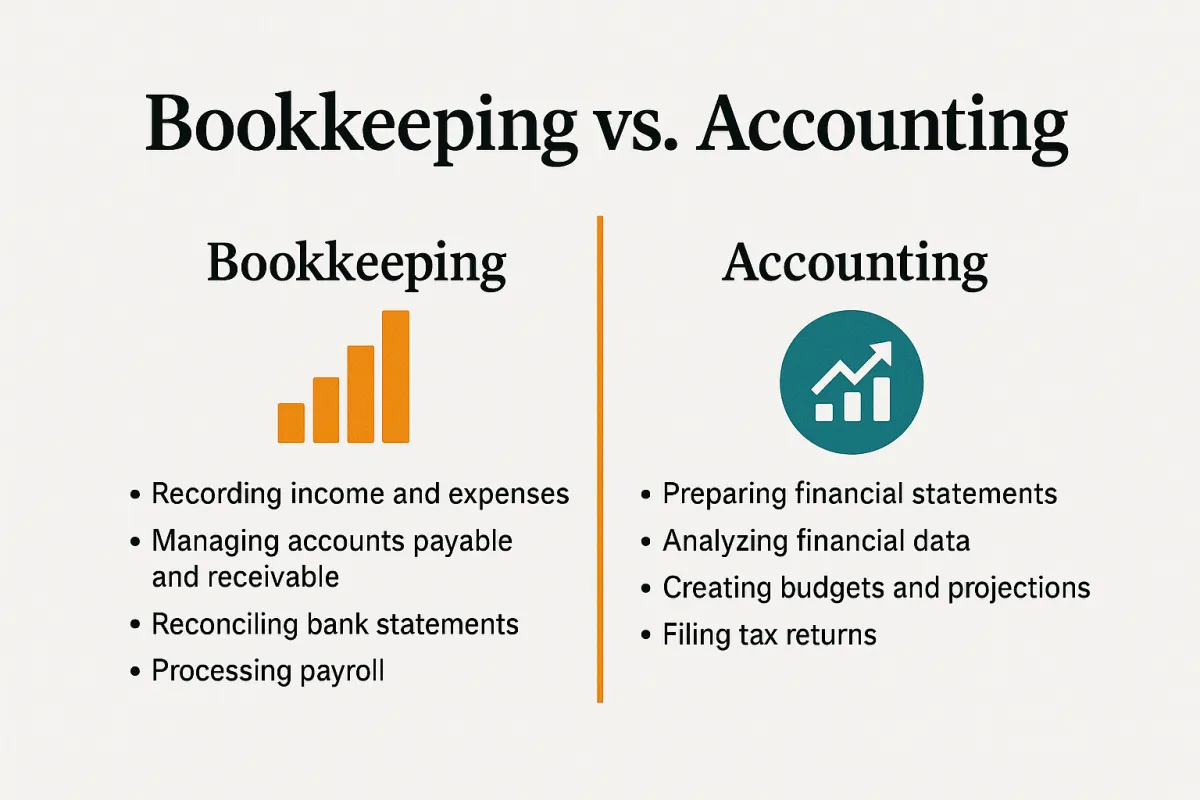
Bookkeeping vs. Accounting: What’s the Real Difference?
By: Top Run Bookkeeping
Let’s Clear This Up Once and for All
If you’ve ever wondered whether bookkeeping and accounting are the same thing—you’re not alone.
A lot of small business owners use the terms interchangeably, but there’s an important distinction between the two.
Both are essential for your business, but they serve different purposes.
Let’s break it down in plain English.
Bookkeeping: The Foundation of Your Finances
Think of bookkeeping as the day-to-day recordkeeping of your business.
Bookkeepers are the ones keeping everything neat, accurate, and up-to-date.
At Top Run Bookkeeping, this includes:
Recording income and expenses
Managing accounts payable and receivable
Reconciling bank and credit card accounts
Tracking payroll and categorizing expenses
Maintaining organized records for tax time
In short: bookkeeping builds the financial base your accountant relies on.
If bookkeeping isn’t accurate, accounting can’t be either.
Accounting: The Bigger Picture
Accounting takes the information provided by bookkeepers and uses it to analyze and interpret your financial health.
It’s more about strategy and decision-making than data entry.
Accountants typically:
Prepare and file tax returns
Analyze financial trends
Create forecasts and budgets
Offer financial advice for growth
In short: accounting turns your bookkeeping data into business insight.
Bookkeepers and Accountants: A Dream Team
A great bookkeeper and a great accountant work hand in hand.
Your bookkeeper keeps the daily numbers organized and accurate—so your accountant can focus on strategy and compliance without wasting hours fixing errors.
At Top Run Bookkeeping, we love partnering with CPAs and accountants because it makes life easier for everyone—especially you, the business owner.
Which One Do You Need?
For most small businesses, the answer is both—but start with bookkeeping.
Without organized records, an accountant can’t do much.
Once your books are in good shape, your accountant can use that data to help you make smart financial decisions and minimize taxes.
So, if your books are behind, messy, or just plain stressful, that’s where we come in.
Let’s Get Your Books in Shape
At Top Run Bookkeeping, we keep your financial data accurate, organized, and ready for your accountant—so you can focus on running your business, not chasing receipts.
We Handle the Numbers, You Run the Business.
Visit TopRunBookkeeping.com to get started.
